Process
Status Items Highlights Done See section below Claims None Questions None Output None
Document Notes
Making an argument on how socialism and innovation can go hand-in-hand. And how, it’s not accurate to say that innovation dies in socialism. It’s to people’s benefit to promote growth, but the key I think is in what that growth means.. better life, not more stuff.
Highlights
id905746350
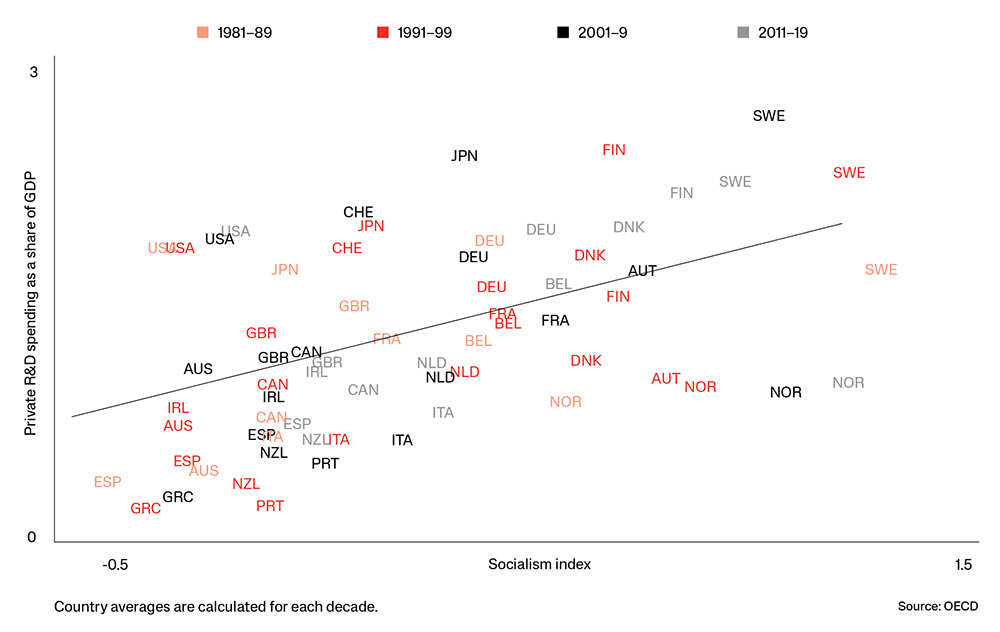
On the x-axis is a “socialism index,” a composite measure I developed that aggregates scores across five indicators: social spending, public ownership, public employment, codetermination, and economic decommodification. On the y-axis is a measure of innovation: private research and development spending as a share of GDP. What we find is not a negative relationship but a positive one. In short, countries with more socialistic characteristics tend to be more innovative, not less.
id905720724
A century ago, Friedrich Hayek and Ludwig von Mises declared that socialism enfeebles the entrepreneurial spirit. Today the familiar refrain is that equality, welfare, and worker power all conspire against innovation.
✏️ Common propaganda that socialism kills innovation. 🔗 View Highlight
id905720850
Sweden files nearly twice as many patents per capita as the United States, and on triadic patents — those filed in the United States, European Union, and Japan — Sweden, Denmark, and Finland are all well ahead of America.
id905720940
It comes down to the custodial institutions of the state: a healthy workforce, robust public education, and public research and development complement private investment and superintend the conditions for sustained innovation. Where workers have a voice — for example, through codetermination and concertation — they are better able to coordinate across sectors and foster long-term skill formation. Innovation becomes less perilous when employment insurance and retraining reduce reliance on any single job. Economic security lowers the cost of failure; it underwrites risk-taking and broadens time horizons. In these settings, productivity gains need not come at human expense.
id905721017
most cleverly realized in Sweden’s postwar labor-market regime, anchored by the Rehn-Meidner model. Its starting point was the “solidarity wage,” which compressed inequality by raising wages at the bottom of the economy and capping them at the top. Low-productivity firms, unable to survive without cheap labor, were gradually displaced. High-productivity firms, now paying less in their highest salaries, could expand more easily. The most efficient firms grew; the least efficient contracted.
id905744936
Consider a stylized example with two countries. Country A pursues moderate productivity growth — say, 2% per year. Country B does not, at 0.5% growth. It isn’t degrowing, but it’s deprioritizing growth. In 35 years, Country A doubles its standard of living. Country B takes 138 years to do so. This rule of thumb is called the “rule of 70”: at 1% growth, it takes 70 years to double your standard of living; at 10%, just 7 years.
id905744836
productivity growth doesn’t require more output — it could just mean working less.
✏️ It could mean that.. but how often does that actually play out that way? 🔗 View Highlight
id905744923
Suppose the average family in each country nets 122,000 versus $105,000. After 25 years, it’s stark — Country A is almost 50% richer. That’s not abstract. It shows up in better services, shorter workweeks, and more freedom from drudgery. And notice that “average incomes” need not mean wages; they can reflect a household’s broader share of economic value. People in Country A could enjoy nicer parks, better transit, and more sustainable infrastructure. If the countries are neighbors, the contrast becomes political. The citizens of Country B, languishing without material progress, will grow restless.
id905745325
A lack of innovation helped lead to the crumbling of the Soviet Union. Stagnation and chronic shortages corroded legitimacy. They were read as a failure of the socialist project itself.
✏️ This is I assume where we get the common trope of socialism=lack of innovation 🔗 View Highlight